Compliance reviews · Restaurants, cafés, bars and takeaways
Website compliance reviews for restaurants, cafés, bars and takeaways
For many restaurants, cafés, bars and takeaways, the website is where a customer checks the allergens, sees the price and pays the deposit. A review checks your menus, ordering, bookings and marketing against the main UK rules that touch a hospitality website, and ends in a written report with a fix list in priority order.
Two years stuck. Through in two weeks.
8Music, a Rayleigh music shop, had spent about two years trying to get through Google Merchant Center. Its account passed Google's review two weeks after we started, in October 2026. That review was against Google's rules, not the UK rules on this page. How 8Music got through
Luke Dykes runs every review, after six years in UK frontline public service, with the police, Border Force and HMRC, where records had to be accurate, complete and able to stand up to scrutiny.
Who it is for
This is for restaurants, cafés, pubs, bars and takeaways whose website does real work: a menu people read before they visit, online ordering for delivery or collection, a booking page that takes a deposit or holds a card, gift vouchers, or private hire and event enquiries. Often the problem was never a decision anyone made. It arrived with a platform or a template: an ordering system that pre-selects a 10% tip, a booking widget whose no-show charge sits in small print, an allergen PDF older than the menu, a menu uploaded as a photo, a service fee that first appears at checkout, or a review badge that stopped updating years ago. The review finds those, says which rule each one touches and gives the fix in words you can paste, or names the setting to change when the fix sits inside your ordering or booking platform.
It is also for caterers, event venues and street food traders who take bookings and deposits, for venues that sell drinks for delivery, and for any owner with one question that needs a straight answer before a new menu, a relaunch or an ad campaign. Do we need calories on our menu? Where do our allergens need to be for online orders? Do we have to show our hygiene rating online? The site can be one we built, one somebody else built or one you put together yourself, and the review covers your own pages and whatever they send customers to. Your listings on Just Eat, Deliveroo or Uber Eats are compared with your own menu, but the platforms' checkouts are theirs to change.
What a review checks
- Allergen information for online and phone orders
- What the menu says about the food
- Prices, fees, tips and card charges
- Deposits, cancellations and no-show charges
- Who customers are ordering from
- Reviews, ratings and awards
- Selling and advertising alcohol
- Booking forms, newsletters and cookies
Allergen information for online and phone orders
When food is ordered online, through an app or by phone, the customer must be able to find out which of the 14 regulated allergens each dish contains, free of charge, before the order is completed and again on delivery. Before the order it can be given in writing or by phone. Food Standards Agency best practice, updated in March 2025, recommends written information that is easy to find, and Food Standards Scotland has its own guidance, but that part is guidance, not law. We check that allergens sit beside each dish or behind a clearly labelled link before anyone can order, or that the page says to call and gives the number, that specials are covered, that the menu is text rather than a photo, and that the site says allergen information comes with the delivery. Accuracy depends on your kitchen, which a website review cannot see.
Source: Regulation (EU) No 1169/2011 on food information and each nation's Food Information Regulations 2014; FSA and Food Standards Scotland allergen guidance
Applies to: Food businesses of every size, in England, Wales, Scotland and Northern Ireland, since December 2014.
What the menu says about the food
Food must not be described in a way that is false or misleads customers about what it is, where it comes from or how it is made, and that covers the website, social posts and delivery listings as much as the printed menu. That is long-standing food law, and consumer protection law bans misleading claims as well. 'Gluten-free' has a legal meaning too: no more than 20 mg of gluten per kilogram, in a restaurant or takeaway as on a packet. We list claims such as 'homemade', 'locally sourced', 'free-range', a named breed or region, 'award-winning' and 'GF', ask what backs each one, and compare the online menu with the venue's and the delivery apps'. Whether a dish can honestly be called gluten-free depends on your kitchen, so the report flags the label for you to settle with FSA guidance or your local authority, and marks nutrition and health claims for a legal view.
Source: Food Safety Act 1990; Food Safety (Northern Ireland) Order 1991; Commission Implementing Regulation (EU) No 828/2014 on gluten-free claims; Digital Markets, Competition and Consumers Act 2024
Applies to: All four UK nations, every size of business, the gluten-free rule included.
Prices, fees, tips and card charges
Every price a customer sees online, on the menu, in the ordering flow or on the booking page must include the charges they cannot avoid: VAT, a compulsory cover or service charge, a booking fee or a per-order service fee. Leaving them until checkout is drip pricing, which the Digital Markets, Competition and Consumers Act 2024 has banned since April 2025. Delivery charges must be shown up front or, where they depend on the address, the customer must be told they apply and how they are worked out. Paid extras and donations must be the customer's own choice, never pre-ticked, and since January 2018 consumers cannot be charged extra for paying by card, mobile wallet or PayPal. We take your ordering and booking flows to the payment step, compare each price with the final total, and check that no tip, donation or extra is pre-selected. Whether a discretionary service charge is truly optional is a legal question, and the report marks it for one.
Source: Digital Markets, Competition and Consumers Act 2024; CMA price transparency guidance (CMA209); Consumer Contracts Regulations 2013; Consumer Rights (Payment Surcharges) Regulations 2012
Applies to: Every business selling to consumers, all of the UK, any size.
Deposits, cancellations and no-show charges
A table booking, an event or catering for a set date carries no 14-day right to cancel, and nor does an order of food that spoils quickly, so your own deposit, cancellation and no-show terms decide what happens. They must be fair and in plain words, and an unfair term does not bind the customer. CMA guidance says money kept on a cancellation should reflect the loss actually suffered, and that a term promising no refund in any circumstances is likely to be unfair. We check that the deposit or card hold, when it is taken and refunded, the cancellation deadline and any no-show charge are shown before the customer pays or enters card details, that the terms say what happens if you cancel, and that the website matches the booking system's emails. Fairness is a legal judgement, so the report flags it and never suggests an amount.
Source: Consumer Contracts Regulations 2013; Consumer Rights Act 2015, Part 2; CMA guidance on unfair contract terms
Applies to: Bookings by consumers rather than companies, all of the UK, any size of business.
Who customers are ordering from
Before someone orders or pays for a booking on your site, they must be able to see who they are buying from: the business behind the restaurant's name, a geographic address and an email address, not only a contact form. The rules on selling online add your VAT number if you are registered, and a limited company must show its registered name, company number, registered office and the part of the UK it is registered in somewhere on its website. We check your own site and any white-label ordering pages it links to, compare the company details with Companies House, and check that the delivery area, minimum order and delivery charges appear before checkout and that customers are told when an order can no longer be cancelled.
Source: Electronic Commerce (EC Directive) Regulations 2002; Consumer Contracts Regulations 2013; Company, Limited Liability Partnership and Business (Names and Trading Disclosures) Regulations 2015
Applies to: All of the UK, any size of business. The company details apply to limited companies.
Reviews, ratings and awards
Since April 2025 it has been banned to write or commission fake reviews, including asking staff or anyone who has not genuinely been a customer to post them, to hide that a review was incentivised, or to present reviews misleadingly, such as showing only the five-star ones. A business that publishes reviews must take reasonable and proportionate steps to prevent and remove fake or misleading ones. A review given for a free drink or a discount must be clearly shown as incentivised, and Google's policy goes further: no incentive for a Google review at all, and no asking only the happy customers. We trace every review, rating and badge on the site, such as 'rated 4.8 on Google' or a Tripadvisor widget, to its source and today's figure, check that awards carry their year, and read any table cards or follow-up emails you share that ask for reviews.
Source: Digital Markets, Competition and Consumers Act 2024; CMA fake reviews guidance (CMA208); Google's user-contributed content policy
Applies to: The law: all of the UK, any size of business. Google's policy is Google's rule, not law, wherever Google reviews are collected.
Selling and advertising alcohol
In England and Wales, selling alcohol to anyone under 18 is an offence, and so is knowingly delivering it to them, and an online or phone sale takes place where the alcohol is picked for the order, so those premises need a licence covering sales off the premises. Scotland has its own licensing law, which requires a Challenge 25 policy at every licensed premises and allows off-sales only from 10am to 10pm, and Northern Ireland has its own licensing law. Your website and social posts also fall under the advertising code's alcohol rules: nothing likely to appeal particularly to under-18s or directed at them, nobody who is or looks under 25 shown drinking or playing a significant role, no link between drinking and social or sexual success, and nothing that encourages drinking to excess. We check for an over-18 statement, an age confirmation before checkout and a note that ID may be checked on delivery, review drinks photos and copy, and flag happy hours, bottomless deals and late delivery times for your licensing adviser, who can also say whether your licence covers delivery.
Source: Licensing Act 2003; Licensing (Scotland) Act 2005; CAP Code alcohol rules
Applies to: Any business selling alcohol for delivery or collection, whatever its size. Licensing law differs between England and Wales, Scotland and Northern Ireland; the advertising code applies across the UK.
Booking forms, newsletters and cookies
Marketing emails and texts to individuals need consent, given by a clear positive choice such as ticking a box that starts unticked, or the soft opt-in, which needs three things: you collected the details yourself in the course of a sale or negotiations for one, which an order or booking can be, you market only your own similar offers, and you gave a simple, free way to opt out then and in every message since. Forms that collect details should link to a privacy notice, and since June 2026 you must give people a way to complain to you about how their data is used. Cookies and tracking pixels need consent unless an exception applies. Since February 2026 one covers analytics used only to improve the site, with visitors told and able to object, but advertising pixels still need a yes, and the ICO says it is still reviewing the consent rules for online advertising. We check booking, newsletter and voucher forms for pre-ticked boxes and a privacy link, and list every tag loaded before and after the cookie banner, checking that saying no is as easy as saying yes.
Source: Privacy and Electronic Communications (EC Directive) Regulations 2003, as amended by the Data (Use and Access) Act 2025; UK GDPR and the Data Protection Act 2018; ICO guidance
Applies to: All of the UK, any size of business.
What it does not cover
This is not legal advice, and I am not a solicitor. A review checks what your website tells customers: that it is there, consistent, easy to find and in line with published rules and guidance. It comes with no certificate or 'compliant' status. It cannot see your kitchen, so food safety management, inspections and hygiene rating appeals sit with your local authority's food team, and whether your allergen information and 'gluten-free' labels are accurate depends on your recipes, suppliers and kitchen controls, as do the labels that go out with deliveries. Your premises licence, whether it covers delivery, and the age checks done at the bar, at the door or by drivers are for you, your licensing authority or a licensing solicitor. Price lists and notices in the venue, how tips and service charges are shared out, staff pay, VAT on food and drink, health and fire safety, and the checkouts and terms of Just Eat, Deliveroo, Uber Eats or your booking platform, beyond what your own site shows customers, are outside the review too. Whether a deposit or no-show term is fair is a question for a solicitor, and the report marks it for one. Nobody outside Google or a regulator can promise what they will decide.
Work in this sector
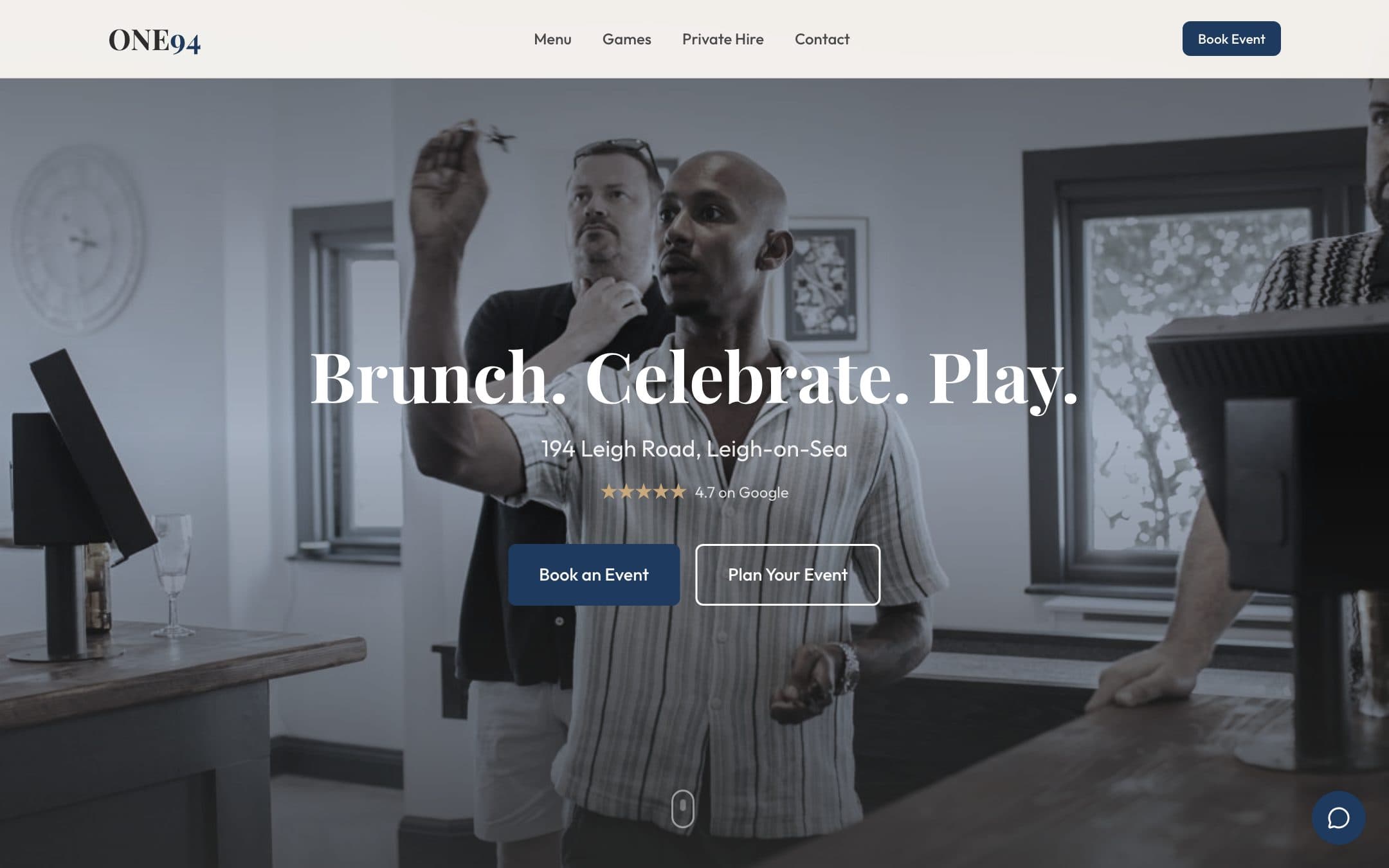
We built the websites for GustoSi, a family-run Italian restaurant, and ONE94, a bar and games venue that takes paid bookings, both on Leigh Road in Leigh-on-Sea, and for Bigs BBQ, a live-fire barbecue caterer in Essex; those were builds, not compliance reviews.

Fair questions
Do we have to put allergens on our online menu?
Do we have to show our food hygiene rating on our website?
We add a service charge. How should our menu and booking page show it?
Does calorie labelling apply to our menu?
We sell through Just Eat, Deliveroo and Uber Eats. Does the review cover those?
Have you reviewed a restaurant's website before?
Tell me what you need. You will get a straight answer and a firm price in writing.
Or call 07438 284755 or email luke@owntimestudios.com.